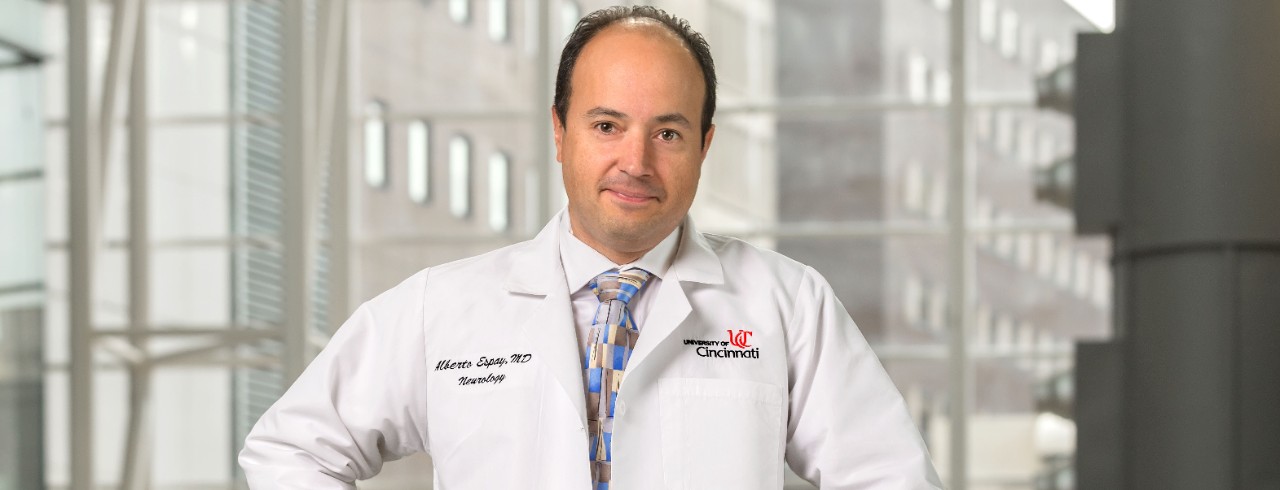
Espay wins Lancet Neurology 20th anniversary essay competition
Essay conveys what future patient visit could look like

An essay on neurology written by Alberto Espay, MD, has won Lancet Neurology’s 20th anniversary essay competition. The essay, “Your After-visit Summary: May 29, 2042” revolves around the diagnostic debriefing to a fictional patient of his new diagnosis of Parkinson’s disease, with biomedical analysis of test results informing a tailored treatment plan.
The essay is available online and will be printed in Lancet Neurology’s 20th anniversary edition in May.
Espay says he was thrilled to win the competition “because it meant that the vision of the essay, a picture vastly different than what we have been doing in caring for our patients, could gain currency with a global readership of neurologists.”
The essay was meant to convey what a future visit with a patient with Parkinson’s disease would look like.
“Rather than saying, ‘You have Parkinson’s based on my experience; trust me,’ we will be saying, 'You have something we have called Parkinson’s, but have no idea what it means,’” Espay says. “We would engage in identifying the biological drivers of each person affected, recognizing that treatments to slow progression can only succeed if tailored to those most biologically suitable to benefit.”
Espay, the James J. and Joan A. Gardner Family Center for Parkinson’s Disease Research Endowed Chair in the Department of Neurology and Rehabilitation Medicine, says medicine is about a decade away from realizing the vision of his essay. He adds the essay was inspired by work currently in progress by the Cincinnati Cohort Biomarker Program, which is trying to unravel the individual biological abnormalities of those affected with neurodegenerative disorders.
“Ultimately, the clinical diagnosis is but a human-made construct about which nature has no idea. And since nature can’t be fooled, we need to be agnostic to our labels and subtype individuals with neurodegenerative disorders according to their biology, not the classification we have used at the bedside for over a century,” he says.
Featured photo at top by Colleen Kelley/UC Creative + Brand
Related Stories
Sugar overload killing hearts
November 10, 2025
Two in five people will be told they have diabetes during their lifetime. And people who have diabetes are twice as likely to develop heart disease. One of the deadliest dangers? Diabetic cardiomyopathy. But groundbreaking University of Cincinnati research hopes to stop and even reverse the damage before it’s too late.
App turns smartwatch into detector of structural heart disease
November 10, 2025

An app that uses an AI model to read a single-lead ECG from a smartwatch can detect structural heart disease, researchers reported at the 2025 Scientific Sessions of the American Heart Association. Although the technology requires further validation, researchers said it could help improve the identification of patients with heart failure, valvular conditions and left ventricular hypertrophy before they become symptomatic, which could improve the prognosis for people with these conditions.
Combination immunotherapy helps overcome melanoma treatment resistance
November 10, 2025

MSN highlighted research led by the University of Cincinnati Cancer Center's Trisha Wise-Draper showing a combination of immunotherapy medications can activate a robust immune response and help overcome treatment resistance in patients with refractory melanoma.