Reuters Health: Merkel cell cancers recur more often than other skin cancers
UC expert says early detection of recurrence is important for treatment

New research shows that Merkel cell carcinoma (MCC) recurs in patients much more often than other skin cancers, often within three years of diagnosis.
MCC is a more rare skin cancer that usually appears as a flesh-colored or bluish-red nodule on the skin, often on the face, head or neck.
Rekha Chaudhary, MD, adjunct associate professor at the UC College of Medicine and a UC Health oncologist, reviewed the research and told Reuters Health that new immunotherapy treatments have proven effective against MCC recurrence, making early detection of recurrence important.
"This study was very helpful in predicting those rates of recurrence," she said. "Following an MCC patient who has had a complete resection closely is very important now, given the new innovative treatments, and national guidelines should be adjusted accordingly."
Read the Reuters Health article.
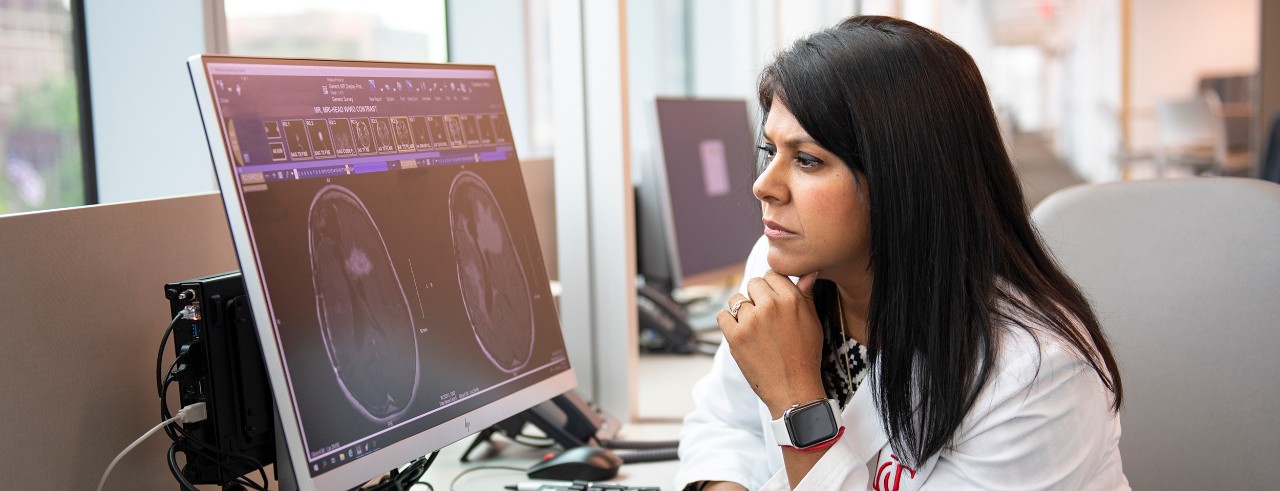
Featured photo at top of Dr. Chaudhary. Photo/Colleen Kelley/University of Cincinnati.
Related Stories
Sugar overload killing hearts
November 10, 2025
Two in five people will be told they have diabetes during their lifetime. And people who have diabetes are twice as likely to develop heart disease. One of the deadliest dangers? Diabetic cardiomyopathy. But groundbreaking University of Cincinnati research hopes to stop and even reverse the damage before it’s too late.
Is going nuclear the solution to Ohio’s energy costs?
November 10, 2025

The Ohio Capital Journal recently reported that as energy prices continue to climb, economists are weighing the benefits of going nuclear to curb costs. The publication dove into a Scioto Analysis survey of 18 economists to weigh the pros and cons of nuclear energy. One economist featured was Iryna Topolyan, PhD, professor of economics at the Carl H. Lindner College of Business.
App turns smartwatch into detector of structural heart disease
November 10, 2025

An app that uses an AI model to read a single-lead ECG from a smartwatch can detect structural heart disease, researchers reported at the 2025 Scientific Sessions of the American Heart Association. Although the technology requires further validation, researchers said it could help improve the identification of patients with heart failure, valvular conditions and left ventricular hypertrophy before they become symptomatic, which could improve the prognosis for people with these conditions.