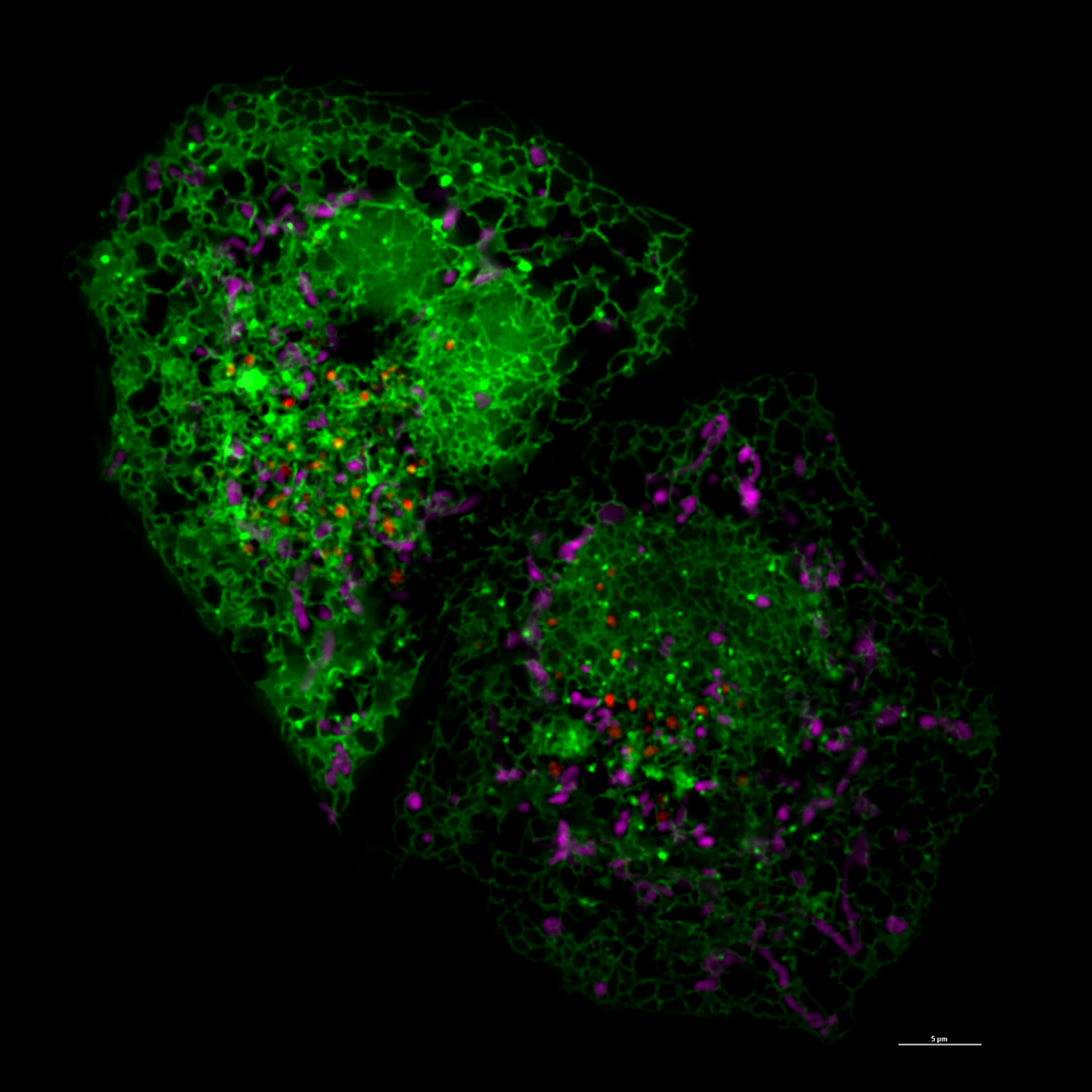
55KRC: UC research advances view at the subcellular level

University of Cincinnati cancer biologists have developed a new piece of technology and a new imaging technique that will help researchers glean more detailed data points and see cells in more precise detail when studying the development of cancer and neurodegenerative diseases.
Jiajie Diao, PhD, associate professor in the Department of Cancer Biology in UC’s College of Medicine, told 55KRC's Simply Medicine that a new probe his team developed helps give more details about the cellular environment, such as pH level.
The probe, combined with a new imaging technique that helps measure the shape, distance and location of tiny parts within cells called organelles. Seeing how the organelles interact can provide more information to how these interactions lead to the development of diseases, he said.
"We are actually working with the most advanced image technique to develop new analysis methods, trying to understand and trying to review subtle changes, changes you couldn’t even notice by your eyes," Diao said. "We’re trying to catch diseases at a very early, early stage."
Listen to the Simply Medicine segment. (Note: Segment begins around 23:40 mark.)
Featured photo at top of super resolution image of cell courtesy of Jiajie Diao.
Related Stories
Sugar overload killing hearts
November 10, 2025
Two in five people will be told they have diabetes during their lifetime. And people who have diabetes are twice as likely to develop heart disease. One of the deadliest dangers? Diabetic cardiomyopathy. But groundbreaking University of Cincinnati research hopes to stop and even reverse the damage before it’s too late.
Is going nuclear the solution to Ohio’s energy costs?
November 10, 2025

The Ohio Capital Journal recently reported that as energy prices continue to climb, economists are weighing the benefits of going nuclear to curb costs. The publication dove into a Scioto Analysis survey of 18 economists to weigh the pros and cons of nuclear energy. One economist featured was Iryna Topolyan, PhD, professor of economics at the Carl H. Lindner College of Business.
App turns smartwatch into detector of structural heart disease
November 10, 2025

An app that uses an AI model to read a single-lead ECG from a smartwatch can detect structural heart disease, researchers reported at the 2025 Scientific Sessions of the American Heart Association. Although the technology requires further validation, researchers said it could help improve the identification of patients with heart failure, valvular conditions and left ventricular hypertrophy before they become symptomatic, which could improve the prognosis for people with these conditions.