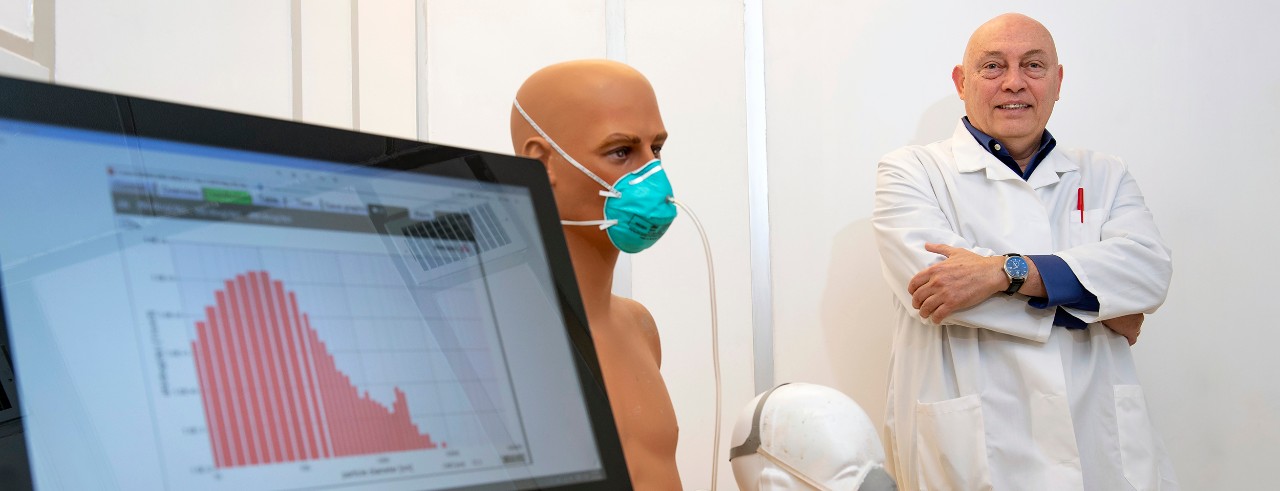
UC part of CDC grant to study the next generation of personal protective equipment
One of the goals is to develop self-decontaminating PPE featuring high-protection efficiency

The University of Cincinnati is part of a multi-institutional grant of nearly $2 million from the Centers for Disease Control and Prevention to improve the design, function and safety of personal protective equipment (PPE).
UC researchers will work with teams from Iowa State University and the University of California-Davis on this four-year grant.
“Here at UC, we have developed promising ideas that will serve as the foundation for a new generation of PPE, particularly novel respiratory protective devices,” says Sergey Grinshpun, PhD, professor in the Department of Environmental and Public Health Sciences and director of the Center for Health Related Aerosol Studies at the UC College of Medicine, who serves a co-principal investigator for the grant.
“In collaboration with our colleagues in material science research from Iowa State and UC-Davis, we aim at developing advanced respirators — with superior properties, such as high efficiency against different aerosols including pathogens, as well as great comfort, wearability and durability,” says Grinshpun. “The present challenges in the PPE arena require innovative solutions, which brought the development of new materials to the forefront of the game. Furthermore, the newly awarded effort will greatly benefit from the multimillion-dollar state-of-the-art respiratory protection research facility that we have built in our laboratories over the years.”

A breathing machine in a lab in the Department of Environmental and Public Health Sciences/Photo/Mike Yermakov/UC
Grinshpun says that this laboratory facility will be used to test various materials and PPE configurations on both mannequins and human subjects. The mannequins are used because human subjects cannot be exposed to harmful aerosols for ethical reasons. Plus, every human subject has their own individual breathing pattern, making it difficult to standardize any protocol for evaluating the efficiency of respirators.
“In contrast,” says Grinshpun, “mannequins can be exposed to harmful aerosol particles, including live viruses, bacteria. The use of breathing simulators (which can replicate any breathing pattern) as well as coughing and sneezing generators developed by our team, will help us standardize the study’s protocols and procedures.”
The main objective for his team at UC (which also includes Tiina Reponen, PhD, professor, and Mikhail Yermakov, senior research assistant) will be to design, develop and evaluate the new generation of facepiece filtering respirators with advanced features, according to Grinshpun.The project will begin with the multi-institutional joint effort focusing on the development of biological self-decontaminating fabrics, which is a key component for improved personal protection against live pathogens. Once the fabrics are developed, the UC team will work on the design of the respirator that deploys the new materials.
The effort is not only multi-institutional but also multi-disciplinary as it involves aerosol physics and engineering, material science, microbiology and molecular biology, exposure science and other scientific disciplines.
Grinshpun says this project has applications that go well beyond health care environments.

A breathing machine in a lab in the Department of Environmental and Public Health Sciences/Photo/Mike Yermakov/UC
“Currently, the general population, which is a much bigger group than the health care workers population, is encouraged to wear PPE, including respiratory protective devices,” he says. “At this point, most of the people wear surgical masks or homemade or improvised face masks; others wear more efficient NIOSH-approved N95 respirators. But all the groups of PPE users are in need of truly efficient, self-decontaminating and comfortable-to-wear devices. Our research will initially address personal protection in health care environments, but it will later target other workplace environments and the general population.”
Grinshpun says the four-year grant is exciting for a number of reasons.
“Although I have participated in several multi-institutional research efforts that aimed at developing new methods or devices, this one is unique because it is the first time that we will target not only a specific component like a gown or respirators but deal with the personal protection concept in its entirety,” he says. “We now, finally, have funds to look at various factors that may improve PPE, plus this grant gives us the opportunity to work with people on the material science front who have studied different combinations of textiles that have a good potential to enhance the protective characteristics of respirators, gowns. It is exciting!”
Featured image at top/Colleen Kelley/UC Creative + Brand
Next Lives Here
The University of Cincinnati is classified as a Research 1 institution by the Carnegie Commission and is ranked in the National Science Foundation's Top-35 public research universities. UC's medical, graduate and undergraduate students and faculty investigate problems and innovate solutions with real-world impact. Next Lives Here.
Related Stories
Sugar overload killing hearts
November 10, 2025
Two in five people will be told they have diabetes during their lifetime. And people who have diabetes are twice as likely to develop heart disease. One of the deadliest dangers? Diabetic cardiomyopathy. But groundbreaking University of Cincinnati research hopes to stop and even reverse the damage before it’s too late.
Is going nuclear the solution to Ohio’s energy costs?
November 10, 2025

The Ohio Capital Journal recently reported that as energy prices continue to climb, economists are weighing the benefits of going nuclear to curb costs. The publication dove into a Scioto Analysis survey of 18 economists to weigh the pros and cons of nuclear energy. One economist featured was Iryna Topolyan, PhD, professor of economics at the Carl H. Lindner College of Business.
App turns smartwatch into detector of structural heart disease
November 10, 2025

An app that uses an AI model to read a single-lead ECG from a smartwatch can detect structural heart disease, researchers reported at the 2025 Scientific Sessions of the American Heart Association. Although the technology requires further validation, researchers said it could help improve the identification of patients with heart failure, valvular conditions and left ventricular hypertrophy before they become symptomatic, which could improve the prognosis for people with these conditions.