UC neurosurgeon awarded grant for tumor research

Matthew Garrett, MD, PhD, who specializes in neuro-oncology, recently received a $50,000 grant from the Neurosurgery Research and Education Foundation.
The 2021-2022 B*CURED and NREF Young Clinician Investigator Award is only given to junior faculty who are pursuing careers as clinical investigators. Only those neurosurgeons who have completed fellowship within the last two years are eligible to apply.

Matthew Garrett, MD, PhD working in his UC lab. Photo/Julie Forbes/University of Cincinnati.
The award-winning project, titled, “Targeting the malignant epigenome of IDH1 mutant gliomas,” intends to investigate a treatment for Diffuse Intrinsic Pontine Glioma (DIPG). DIPG is a rare brainstem tumor that occurs primarily in children. There is currently no cure, and it is universally fatal.
"The most commonly accepted hypothesis is that the tumors are initiated when a mutation affects the way the tumor DNA is folded and arranged,” said Garrett, assistant professor of clinical neurosurgery in the University of Cincinnati College of Medicine and a UC Health Neurosurgeon at the UC Gardner Neuroscience Institute.
Garrett’s study proposes using chaetoin, an untested compound discovered from a drug screen of hundreds of different compounds, to make tumor cells more sensitive to radiation.
Garrett will test the efficacy of this compound by injecting the human tumor cells into mice. His study will both treat the mice with this new compound and will also treat the mice with the compound in combination with other promising therapies like radiation and Panobinostat.
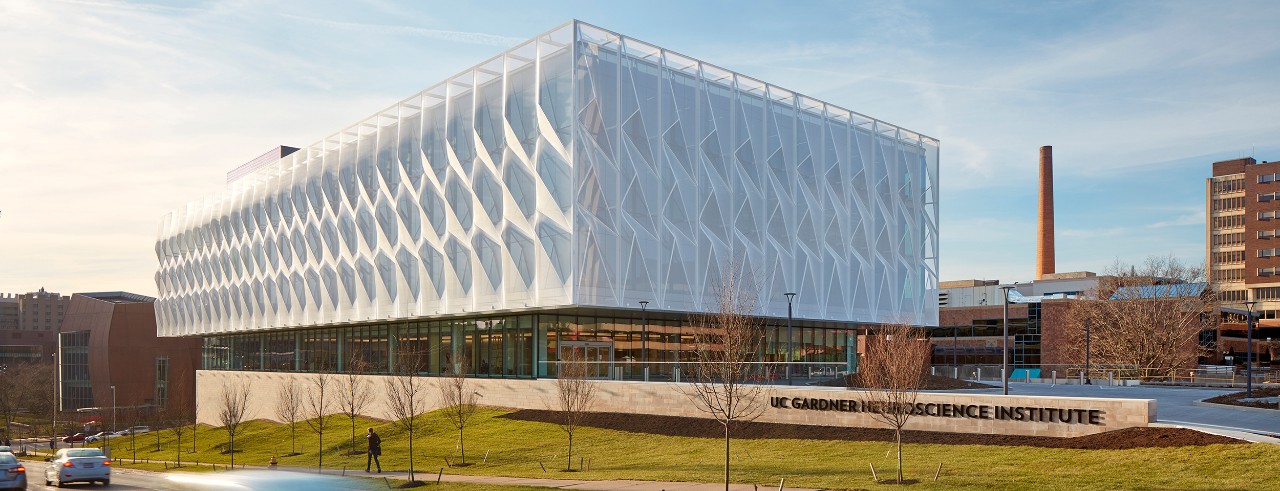
Featured photo at top of UC Gardner Neuroscience Institute by Mark Herboth.
Related Stories
Sugar overload killing hearts
November 10, 2025
Two in five people will be told they have diabetes during their lifetime. And people who have diabetes are twice as likely to develop heart disease. One of the deadliest dangers? Diabetic cardiomyopathy. But groundbreaking University of Cincinnati research hopes to stop and even reverse the damage before it’s too late.
App turns smartwatch into detector of structural heart disease
November 10, 2025

An app that uses an AI model to read a single-lead ECG from a smartwatch can detect structural heart disease, researchers reported at the 2025 Scientific Sessions of the American Heart Association. Although the technology requires further validation, researchers said it could help improve the identification of patients with heart failure, valvular conditions and left ventricular hypertrophy before they become symptomatic, which could improve the prognosis for people with these conditions.
Combination immunotherapy helps overcome melanoma treatment resistance
November 10, 2025

MSN highlighted research led by the University of Cincinnati Cancer Center's Trisha Wise-Draper showing a combination of immunotherapy medications can activate a robust immune response and help overcome treatment resistance in patients with refractory melanoma.