Local 12: 180 UC med students receive white coats, students embark on journey during pandemic
College of Medicine receives highest number of applications ever

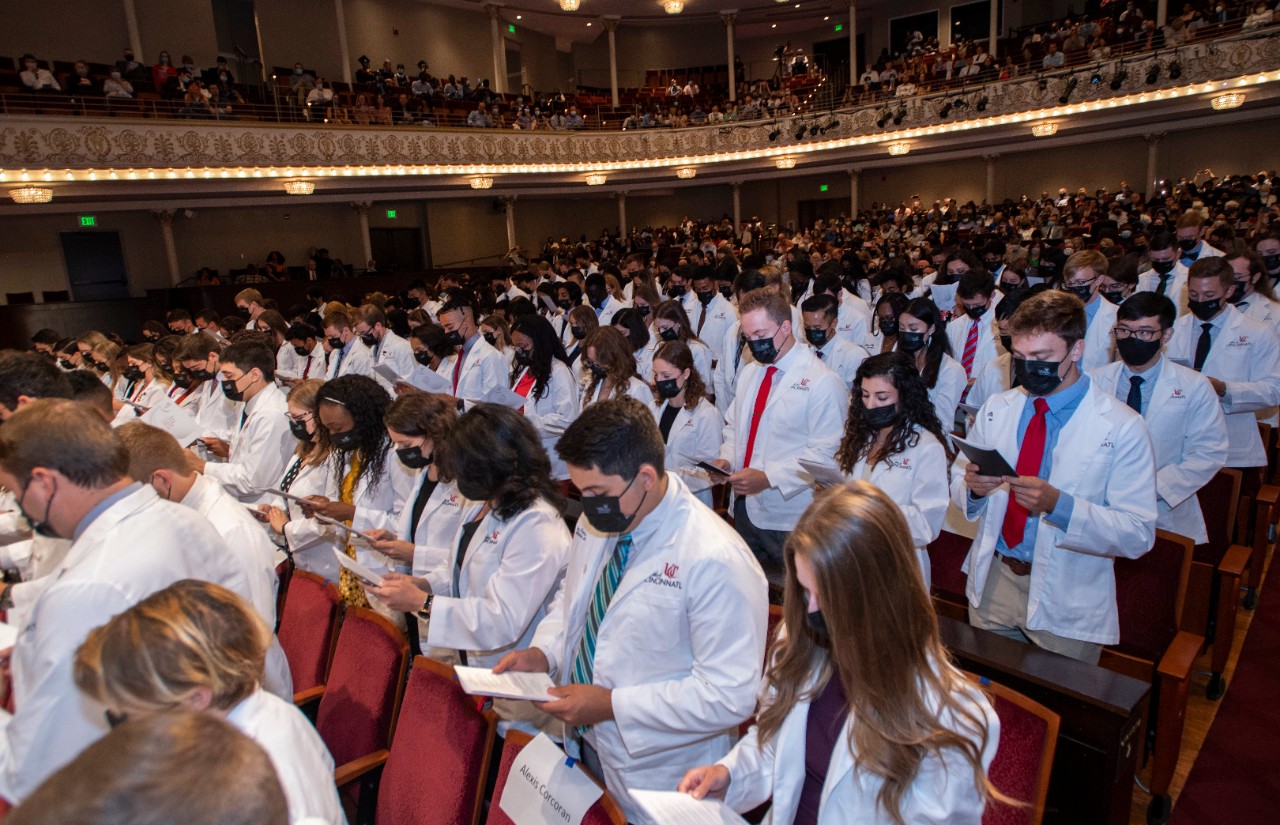
The UC College of Medicine welcomed 180 newly admitted first-year students during the college’s 26th annual White Coat Ceremony, held Friday, Aug. 6 at Cincinnati Music Hall.
Each member of the class of 2025 was presented with a white lab coat, symbolizing entry into the medical profession.
WKRC-TV, Local 12 covered the event, talking with newly admitted medical students Alex Cooke and Grace Sharf.
“It's nice to start with a purpose,” Cooke said. The purpose to serve becomes even more important as the COVID-19 pandemic continues to rage.
“It's definitely kind of scary to come into this especially with delta getting worse,” Scharf said, adding the pandemic only made her want to take her career to the next level.

Phillip Diller, MD, Senior Associate Dean for Educational Affairs at the UC College of Medicine speaks at the 2021 White Coat Ceremony/Photo/Joe Fuqua II/UC Creative + Brand
“I worked as an EMT or a first responder throughout the pandemic and I just wanted to be able to do more and help people further throughout the pandemic so I'm really excited to be here,” Scharf said.
That feeling is mutual for Cooke.
“Seeing what people went through, I worked in a hospital, I worked with COVID patients, so seeing what the doctors, the nurses, and techs, the pharmacy, physical therapy everyone what they were doing, it kind of galvanized me in that respect, because I knew what I wanted to do beforehand but it kind of put it in a sharper, clearer perspective of what it entails to do that,” Cooke said.
The College of Medicine received more than 6,100 applications for the class of 2025, the most the college has ever received and an increase of more than 20% from the previous year.
“It's a time where they're going to be tasked for a lot. they will be very successful I'll tell you, all of them," Alvin Crawford, MD, Professor emeritus of orthopedic surgery at UC’s College of Medicine told Local 12. "There will be obstacles but it will cause them to actually step it up and I think will be better off in the end of it but it's going to be a little bit different.”
The 180 new students were welcomed to the event by Philip Diller, MD, Senior Associate Dean for Educational Affairs at the College of Medicine.
"The education you are embarking on is not a medical course, but rather a life course, for which a few years in medical school is but a preparation," said Diller. "We look forward to getting to know each of you over the next four years as individuals; nurturing your strengths, helping you work through and overcome the challenges, and assisting you in your decision about what sort of doctor you wish to be."
See the entire Local 12 story here.
Lead photo/Joe Fuqua II/UC Creative + Brand
Next Lives Here
The University of Cincinnati is classified as a Research 1 institution by the Carnegie Commission and is ranked in the National Science Foundation's Top-35 public research universities. UC's medical, graduate and undergraduate students and faculty investigate problems and innovate solutions with real-world impact. Next Lives Here.
Related Stories
Sugar overload killing hearts
November 10, 2025
Two in five people will be told they have diabetes during their lifetime. And people who have diabetes are twice as likely to develop heart disease. One of the deadliest dangers? Diabetic cardiomyopathy. But groundbreaking University of Cincinnati research hopes to stop and even reverse the damage before it’s too late.
Is going nuclear the solution to Ohio’s energy costs?
November 10, 2025

The Ohio Capital Journal recently reported that as energy prices continue to climb, economists are weighing the benefits of going nuclear to curb costs. The publication dove into a Scioto Analysis survey of 18 economists to weigh the pros and cons of nuclear energy. One economist featured was Iryna Topolyan, PhD, professor of economics at the Carl H. Lindner College of Business.
App turns smartwatch into detector of structural heart disease
November 10, 2025

An app that uses an AI model to read a single-lead ECG from a smartwatch can detect structural heart disease, researchers reported at the 2025 Scientific Sessions of the American Heart Association. Although the technology requires further validation, researchers said it could help improve the identification of patients with heart failure, valvular conditions and left ventricular hypertrophy before they become symptomatic, which could improve the prognosis for people with these conditions.