Forbes: UC telehealth drone can make house calls
A multidisciplinary team of researchers is engineering new technology

Telehealth medicine has become increasingly popular during the COVID-19 pandemic as doctors and patients turned to virtual appointments as a means to communicate more safely.
Forbes highlighted research by a multidisciplinary team of inventors at the University of Cincinnati that is aiming to improve the technology to make these virtual interactions more meaningful.
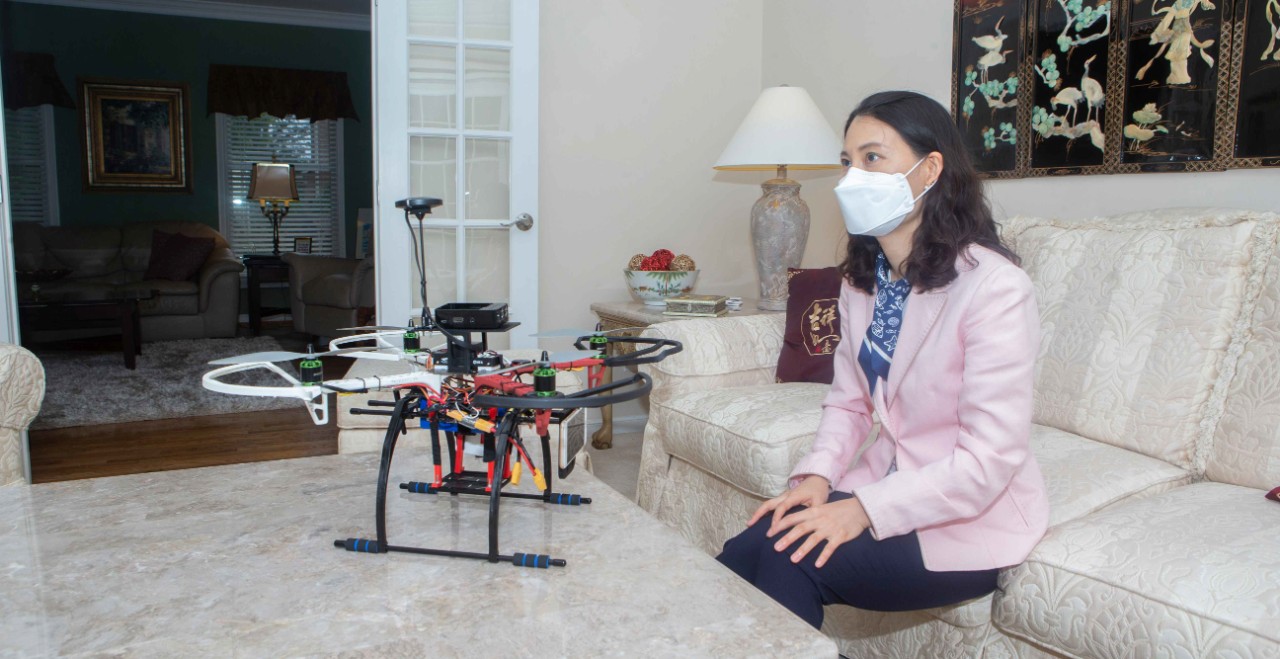
Inventors Victoria Wangia-Anderson, Manish Kumar, Seung-Yeon Lee and Debi Sampsel from three colleges at UC collaborated to develop a semi-autonomous drone that can be dispatched to people’s homes. The drones are big enough to carry medicine or medical supplies but small enough to maneuver the tight confines of a home using navigational algorithms developed by UC engineers.
Still in development, the drone has cameras and a display screen so patients can talk to health care professionals from the comfort of their home. The prototype carries a waterproof box the size of a small first-aid kit to deliver medical supplies or collect self-administered lab tests.
The researchers in UC’s College of Nursing, College of Allied Health Sciences and College of Engineering and Applied Science secured a UC Office of Research grant to develop a prototype to test the feasibility of dispatching a telehealth care delivery drone to a patient's home to provide health assessments or medical interventions.
Featured image at top: Seung-Yeon Lee, an associate professor of nutrition sciences in UC's College of Allied Health Sciences, sits across from a telehealth drone that allows patients to talk face-to-face to health care professionals from the comfort of their home. Photo/Joseph Fuqua II/UC Creative + Brand

UC's prototype telehealth drone. Photo/Joseph Fuqua II/UC Creative + Brand
Related Stories
Sugar overload killing hearts
November 10, 2025
Two in five people will be told they have diabetes during their lifetime. And people who have diabetes are twice as likely to develop heart disease. One of the deadliest dangers? Diabetic cardiomyopathy. But groundbreaking University of Cincinnati research hopes to stop and even reverse the damage before it’s too late.
Is going nuclear the solution to Ohio’s energy costs?
November 10, 2025

The Ohio Capital Journal recently reported that as energy prices continue to climb, economists are weighing the benefits of going nuclear to curb costs. The publication dove into a Scioto Analysis survey of 18 economists to weigh the pros and cons of nuclear energy. One economist featured was Iryna Topolyan, PhD, professor of economics at the Carl H. Lindner College of Business.
App turns smartwatch into detector of structural heart disease
November 10, 2025

An app that uses an AI model to read a single-lead ECG from a smartwatch can detect structural heart disease, researchers reported at the 2025 Scientific Sessions of the American Heart Association. Although the technology requires further validation, researchers said it could help improve the identification of patients with heart failure, valvular conditions and left ventricular hypertrophy before they become symptomatic, which could improve the prognosis for people with these conditions.