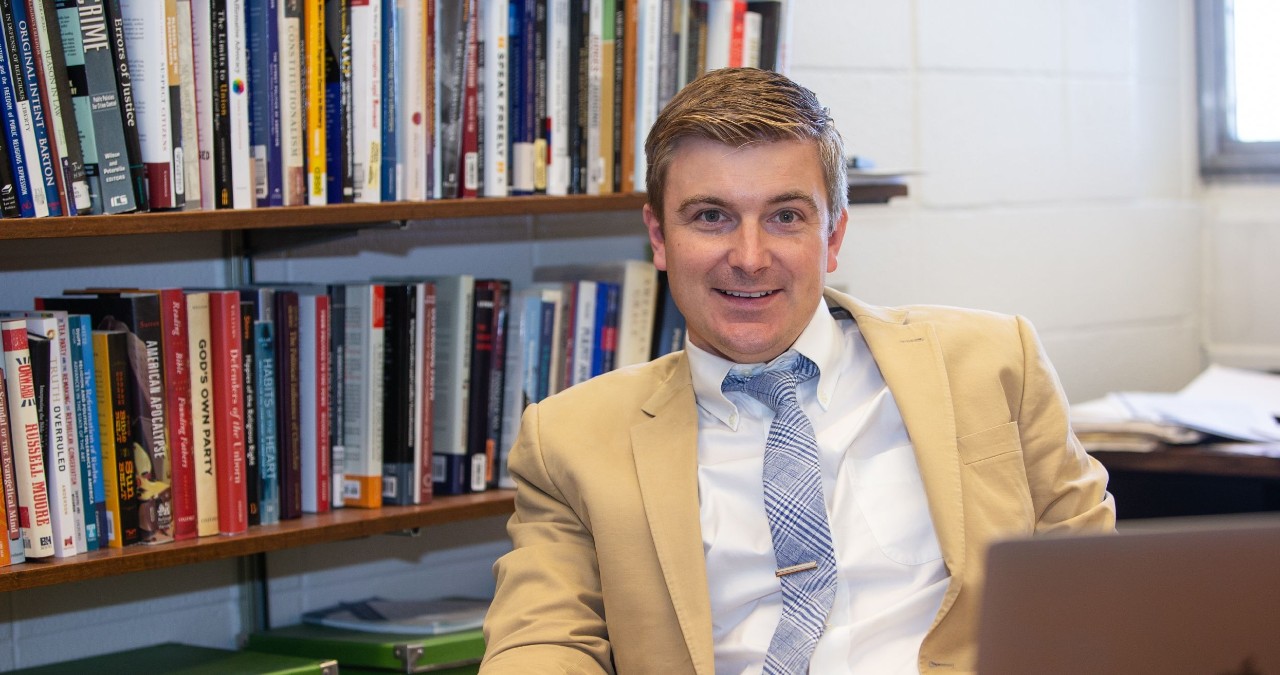
UC political scientist Andrew Lewis weighs in on recent Supreme Court ruling
The UC Department of Political Science is widely recognized as a source of expert opinion

The interface between religion and politics has gained much attention of late, most recently with the Supreme Court ruling in Fulton v. City of Philadelphia.
In this case, the court ruled unanimously that the First Amendment’s religious-freedom protections prevent the city of Philadelphia from refusing to contract with a Catholic foster-care agency that, based on its religious beliefs, does not place foster children with same-sex couples.
This case, however, is just a sampling of the groundswell of public debate over where the line is drawn and where it blurs, regarding religious freedom and the law, as University of Cincinnati political scientist Andrew Lewis explains in a June 2020 article he wrote for The Atlantic.
Not long ago, religious freedom used to cut across groups and cross partisan lines, but this no longer holds fast, notes Lewis, an associate professor and researcher in the College of Arts and Sciences' Department of Political Science. Lewis' areas of expertise are conservative politics and religion and politics, with a focus on evangelical political engagement.
Lewis elaborates on his statement in a more expansive article in The Washington Post by pointing to his latest research which explored how support for religious freedom increases when people are exposed to stories of religious minorities claiming rights.
“My research suggests that the public is more responsive to controversial religious freedom claims when they are exposed to religious freedom arguments made by minority groups such as Muslims," he says. "When Democrats no longer think of religious freedom as solely a Christian issue, they respond more favorably.”
Read more from Andrew Lewis
- USA TODAY: Pandemic response and Christian vote
- ABC News: Religious freedom in America: popular and polarizing
- HuffPost: Liberty Counsel urges churches to reopen
Featured image at top of Andrew Lewis. Photo/Andrew Higley/UC Creative + Brand
Impact Lives Here
The University of Cincinnati is leading public urban universities into a new era of innovation and impact. Our faculty, staff and students are saving lives, changing outcomes and bending the future in our city's direction. Next Lives Here.
Related Stories
Sugar overload killing hearts
November 10, 2025
Two in five people will be told they have diabetes during their lifetime. And people who have diabetes are twice as likely to develop heart disease. One of the deadliest dangers? Diabetic cardiomyopathy. But groundbreaking University of Cincinnati research hopes to stop and even reverse the damage before it’s too late.
Is going nuclear the solution to Ohio’s energy costs?
November 10, 2025

The Ohio Capital Journal recently reported that as energy prices continue to climb, economists are weighing the benefits of going nuclear to curb costs. The publication dove into a Scioto Analysis survey of 18 economists to weigh the pros and cons of nuclear energy. One economist featured was Iryna Topolyan, PhD, professor of economics at the Carl H. Lindner College of Business.
App turns smartwatch into detector of structural heart disease
November 10, 2025

An app that uses an AI model to read a single-lead ECG from a smartwatch can detect structural heart disease, researchers reported at the 2025 Scientific Sessions of the American Heart Association. Although the technology requires further validation, researchers said it could help improve the identification of patients with heart failure, valvular conditions and left ventricular hypertrophy before they become symptomatic, which could improve the prognosis for people with these conditions.