KOMO News: UC identifies hot spots in opioid crisis
Black men ages 30 to 34 face increasing risk from epidemic

KOMO News 4 in Seattle, Washington, highlighted a new study by the University of Cincinnati that identified national hot spots in the ongoing opioid epidemic.
UC's Health Geography and Disease Modeling Laboratory found that the opioid epidemic is taking a deadly toll on people in disproportionate clusters.
Published in the journal PLOS One, the study demonstrates how both widespread and localized the problem of substance use disorders can be, co-author Diego Cuadros said.
“Not everyone is similarly at risk,” said Cuadros, assistant professor of geography in UC's College of Arts and Sciences. “We wanted to identify characteristics that put people at higher risk of a fatal overdose.”
Researchers found that white males ages 25 to 29 were most at risk of fatal opioid overdose followed by white males ages 30 to 34. The study also identified an increasing risk to Black males ages 30 to 34.
"Prevention is important," Cuadros told KOMO News. "Maybe most of the interventions right now have been focused on the white population. So you tell the Black community that this is a problem that is also going to be affecting them in the near future, so we need to be prepared about that and we need to be prepared about what type of services we're going to provide to this population, this community."
Researchers also examined the link between substance abuse and mental health, finding that mental health issues increased the risk of death from a drug overdose by 39 percent.
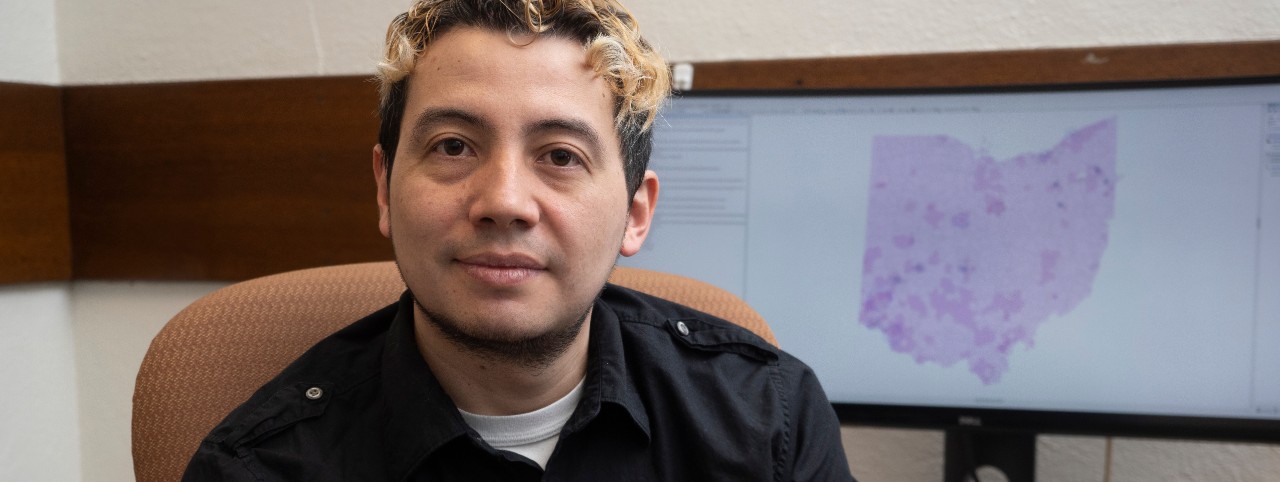
Featured image at top: UC graduate Andres Hernandez was lead author of a study on the national opiate epidemic. Photo/Jay Yocis/UC Creative + Brand

A map of the contiguous United States shows the spatial distribution of relative risk for fatal overdoses from substance use disorder in 25 identified clusters. Graphic/UC
Related Stories
Sugar overload killing hearts
November 10, 2025
Two in five people will be told they have diabetes during their lifetime. And people who have diabetes are twice as likely to develop heart disease. One of the deadliest dangers? Diabetic cardiomyopathy. But groundbreaking University of Cincinnati research hopes to stop and even reverse the damage before it’s too late.
Is going nuclear the solution to Ohio’s energy costs?
November 10, 2025

The Ohio Capital Journal recently reported that as energy prices continue to climb, economists are weighing the benefits of going nuclear to curb costs. The publication dove into a Scioto Analysis survey of 18 economists to weigh the pros and cons of nuclear energy. One economist featured was Iryna Topolyan, PhD, professor of economics at the Carl H. Lindner College of Business.
App turns smartwatch into detector of structural heart disease
November 10, 2025

An app that uses an AI model to read a single-lead ECG from a smartwatch can detect structural heart disease, researchers reported at the 2025 Scientific Sessions of the American Heart Association. Although the technology requires further validation, researchers said it could help improve the identification of patients with heart failure, valvular conditions and left ventricular hypertrophy before they become symptomatic, which could improve the prognosis for people with these conditions.