Better-fitting face masks greatly improve COVID-19 protection
UC researchers found that leaks around the edges of masks increase infection risk

Even the best face masks work only as well as their fit.
And poorly fitting face masks greatly increase the risk of infection from airborne pathogens compared to custom-fitted masks, according to a new study by the University of Cincinnati.
Researchers in UC’s College of Engineering and Applied Science used computerized tomography or CT scans of three different-sized face masks attached to three different-sized dummy heads to measure the gaps between the face and the fabric. Then they calculated the leaks from these gaps to determine the infection risk.
They found that while N95 masks are effective barriers against airborne diseases like COVID-19, poorly fitting masks can have substantial leaks around the face that reduce their effectiveness and increase the risk of infection.

UC College of Engineering and Applied Science professor Rupak Banerjee adjusts a face mask on volunteer and UC graduate student Israel Ajiboye while grad student Shreyash Manegaonkar looks on during a demonstration in Banerjee's lab. Researchers found that a face mask's fit makes all the difference in protecting the wearer and others from infectious disease. Photo/Ravenna Rutledge/UC Creative + Brand
“Many people do not realize that the fit of face masks can vary. There are different face shapes and different sizes of masks,” said Rupak Banerjee, a professor in UC’s Department of Mechanical and Materials Engineering.
“If you do not match them well, you can lead to greater leaks and higher risks of infection,” he said.
The study was published in the Nature journal Scientific Reports.

UC researchers found that a poorly fitted face mask greatly increases the risk of infection. Photo/Ravenna Rutledge/UC Creative + Brand
Banerjee collaborated on the study with his former students, including UC graduates Prasanna Hariharan, Neha Sharma and Gavin D’Souza. Hariharan, the study’s lead author, works for the U.S. Food and Drug Administration’s Division of Applied Mechanics.
UC’s use of CT scans improved the accuracy of contact modeling from previous studies that relied on gap geometry and computational models for estimates.
UC used three different sized N95 face masks from the National Institute for Occupational Safety and Health along with three standard mannequin heads identified as small, medium and large. From the CT scans, they could create a 3D computer-aided design model that showed the gaps between the masks and the face on each subject.
They calculated the airflow rates through the gaps to identify the relative infection risk for each mask on each face.
The aerosol transport attributed to leaking out the sides of the masks varied from as little as 30% to as much as 95% for the worst-fitting masks. Researchers found the leaks were most likely around the nose. Interestingly, they noticed that the gaps were often asymmetrical on the symmetrical dummy faces.

CT scans and a computational analysis of air flow helped UC researchers identify where leaks in three different sized masks occurred on three different sized heads. Graphic/Scientific Report
Researchers found that poorly fitted face masks can as much as double the infection risk to the wearers and people around them.
“A lot of people don’t wear masks properly. They keep the nose exposed, which isn’t helpful,” Banerjee said.

UC professor Rupak Banerjee studied the fit of face masks during the COVID-19 pandemic. Photo/Ravenna Rutledge/UC Creative + Brand
But understanding that masks can often leak around the nose could help people pay more attention to the fit when buying and wearing masks.
Editor of the American Society of Mechanical Engineering Journal of Medical Devices, Banerjee said innovations in infection control have been hot topics this year.
“We are going to have a special issue soon about pandemic-response medical devices, including face masks and face shields,” he said.
Meanwhile, UC’s research could educate consumers and help manufacturers design better-fitting masks, he said.
While many countries are relaxing social-distancing mandates, Banerjee said he isn’t putting his face masks away just yet.
“I’ll continue to wear a face mask because of the risk from the COVID-19 variants,” he said. “We’re still not sure how effective the vaccine is on the variants. So it’s a good idea to continue wearing masks in gatherings for now.”

UC Professor Rupak Banerjee has co-authored hundreds of studies on diverse medical and engineering topics in UC's College of Engineering and Applied Science. Photo/Ravenna Rutledge/UC Creative + Brand

UC College of Engineering and Applied Science professor Rupak Banerjee talks to UC graduate students Shreyash Manegaonkar, Israel Ajiboye and Navaneeth Chandran about the face mask research. Photo/Ravenna Rutledge/UC Creative + Brand
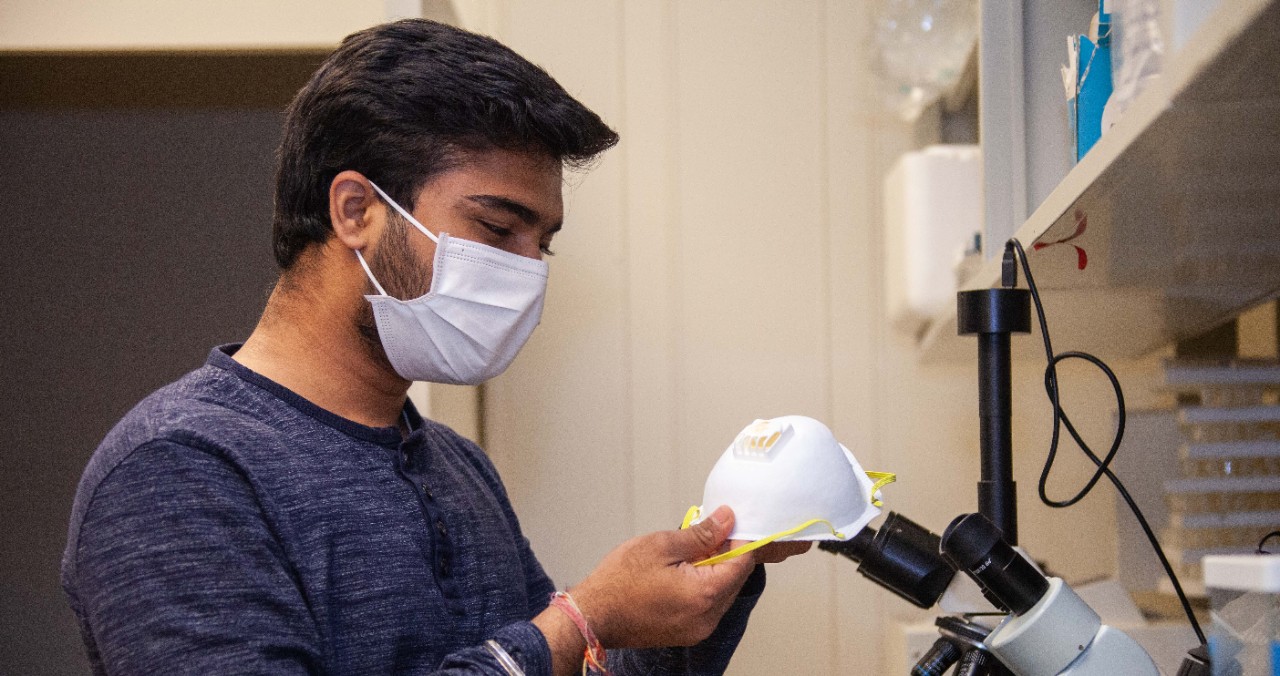
Featured image at top: UC graduate student Shreyash Manegaonkar examines an N95 face mask. Photo/Ravenna Rutledge/UC Creative + Brand
More UC face mask research

UC researchers have studied a myriad of topics around face masks during the COVID-19 pandemic, from the best fabrics for homemade masks to custom 3D-printed ones. Photo/Joseph Fuqua II/UC Creative + Brand
- Elastic-free masks can help some with allergies stay safe during pandemic
- UC students design custom 3D-printed face masks
- Silk could be homemade solution for COVID-19 prevention
- Atlanta Journal Constitution: Here's why your face mask could be making you itchy
- UC researchers aim to make heatable, reusable face masks
Impact Lives Here
The University of Cincinnati is leading public urban universities into a new era of innovation and impact. Our faculty, staff and students are saving lives, changing outcomes and bending the future in our city's direction. Next Lives Here.
Stay up to date on all UC's COVID-19 stories, or take a UC virtual visit and begin picturing yourself at an institution that inspires incredible stories.
Related Stories
Sugar overload killing hearts
November 10, 2025
Two in five people will be told they have diabetes during their lifetime. And people who have diabetes are twice as likely to develop heart disease. One of the deadliest dangers? Diabetic cardiomyopathy. But groundbreaking University of Cincinnati research hopes to stop and even reverse the damage before it’s too late.
Is going nuclear the solution to Ohio’s energy costs?
November 10, 2025

The Ohio Capital Journal recently reported that as energy prices continue to climb, economists are weighing the benefits of going nuclear to curb costs. The publication dove into a Scioto Analysis survey of 18 economists to weigh the pros and cons of nuclear energy. One economist featured was Iryna Topolyan, PhD, professor of economics at the Carl H. Lindner College of Business.
App turns smartwatch into detector of structural heart disease
November 10, 2025

An app that uses an AI model to read a single-lead ECG from a smartwatch can detect structural heart disease, researchers reported at the 2025 Scientific Sessions of the American Heart Association. Although the technology requires further validation, researchers said it could help improve the identification of patients with heart failure, valvular conditions and left ventricular hypertrophy before they become symptomatic, which could improve the prognosis for people with these conditions.