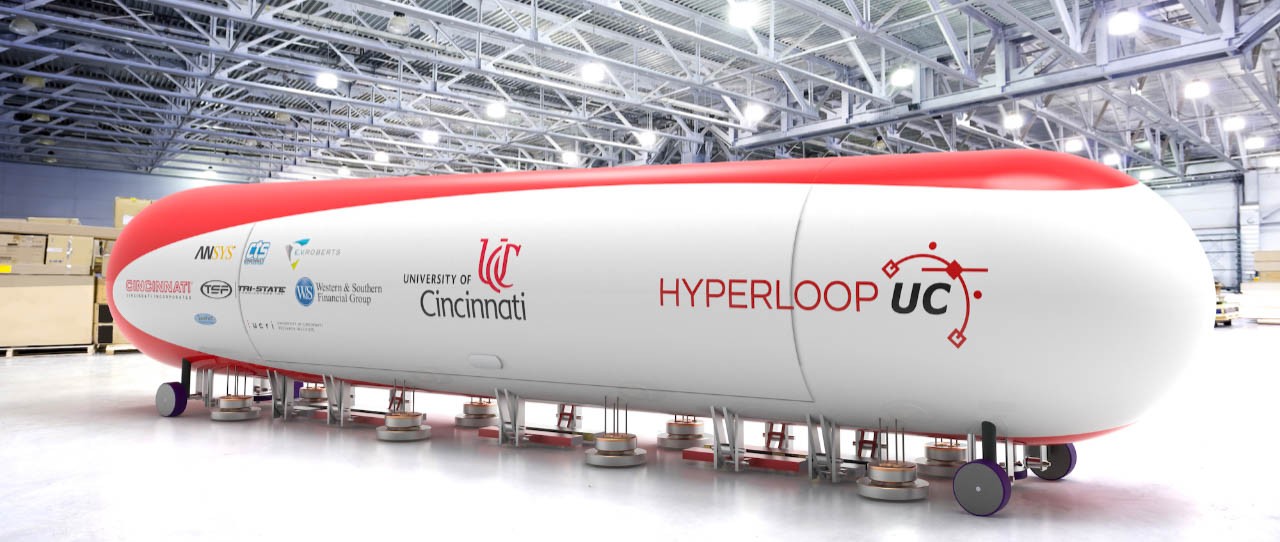
WVXU: UC makes finals of 'boring' Hyperloop competition
Boring? Hardly. UC at forefront of new transportation.

WVXU talked to University of Cincinnati students about making the finals of Elon Musk's international tunnel-boring competition for Hyperloop.
Hyperloop UC is among 12 finalists in the race to build more efficient boring technology for high-speed travel tubes.
The Not-A-Boring Competition asks UC and other teams to build a 30-meter tunnel with a roughly 18-inch diameter through which a remote-controlled car will travel.
Hyperloop consists of a sealed tube in which a pod elevated by magnets is propelled at speeds of more than 700 mph through a partial vacuum.
The goal of the new competition is to develop the faster but accurate tunneling technology needed to realize the dream of high-speed Hyperloop transportation. Teams will be judged on how fast they build the tunnel and how accurate the tunnel navigation is to its underground target.
I could get from Cincinnati to Chicago in 22 minutes.
Jake Gerbracht, Hyperloop UC
UC will compete against teams from the United States, the United Kingdom, Germany, Canada and Switzerland.
Hyperloop UC beat out nearly 400 other teams in the technical design review to make the final 12 expected to compete this summer. Hyperloop UC faculty adviser Laura Pinelo told WVXU the team overcame the hurdles of working remotely on the project during the COVID-19 pandemic to make the finals.
UC students have spent years developing the new transportation. Hyperloop UC competed against international teams in 2017 at SpaceX in California.
"I could get from Cincinnati to Chicago in 22 minutes," Hyperloop UC President Jake Gerbracht told WVXU.
Musk is pursuing high-speed Hyperloop routes across the United States.

SpaceX founder Elon Musk talks to UC students during the 2017 Hyperloop competition at SpaceX. Photo/Jay Yocis/UC Creative + Brand
Related Stories
Sugar overload killing hearts
November 10, 2025
Two in five people will be told they have diabetes during their lifetime. And people who have diabetes are twice as likely to develop heart disease. One of the deadliest dangers? Diabetic cardiomyopathy. But groundbreaking University of Cincinnati research hopes to stop and even reverse the damage before it’s too late.
Is going nuclear the solution to Ohio’s energy costs?
November 10, 2025

The Ohio Capital Journal recently reported that as energy prices continue to climb, economists are weighing the benefits of going nuclear to curb costs. The publication dove into a Scioto Analysis survey of 18 economists to weigh the pros and cons of nuclear energy. One economist featured was Iryna Topolyan, PhD, professor of economics at the Carl H. Lindner College of Business.
App turns smartwatch into detector of structural heart disease
November 10, 2025

An app that uses an AI model to read a single-lead ECG from a smartwatch can detect structural heart disease, researchers reported at the 2025 Scientific Sessions of the American Heart Association. Although the technology requires further validation, researchers said it could help improve the identification of patients with heart failure, valvular conditions and left ventricular hypertrophy before they become symptomatic, which could improve the prognosis for people with these conditions.