Two virtual symposiums celebrate College of Medicine research in March
Environmental Genetics and Internal Medicine highlight faculty, staff and trainee research

Researchers in the University of Cincinnati College of Medicine are sharing their research findings virtually with two major symposiums happening online in March.
The Center for Environmental Genetics (CEG) in the Department of Environmental and Public Health Sciences will host a virtual daylong symposium on Friday, March 19, while the UC Department of Internal Medicine will hold its 10th annual research symposium, titled “Building the Next Generation of Researchers,” starting Tuesday, March 30 and continuing until Thursday, April 1.
Researchers associated with the CEG are leaders in the study of gene-environment interactions and the translations of research into advances in primary prevention and bedside care. Special attention in the CEG is devoted to the early origins of disease, the interplay between genetics and epigenetics and the influence of lifestyle modifiers such as diet or stress on epigenetic reprogramming.

Linda Birnbaum, PhD
Linda Birnbaum, PhD, former director of the National Institute of Environmental Health Sciences and the National Toxicology Program, will keynote the symposium with the speech, “The Perils of PFAS.” Birnbaum is an adjunct professor at the University of North Carolina at Chapel Hill School of Global Public Health.
Often called “forever chemicals,” PFAS or polyfluoroalkyl substances are human-made chemicals used in everyday products such as nonstick cookware, food containers or wrappers, carpets and cleaning products along with personal care products like shampoo, sunscreen, waterproof mascaras and eyeliners. PFAS have been linked to low infant birth weights, kidney and testicular cancer and increased cholesterol levels.
Eight UC researchers will present research updates. Susan Pinney, PhD, director of the CEG and professor in the Department of Environmental and Public Health Sciences, will open the symposium at 9 a.m. Activities should conclude around 3 p.m. To receive program details and a weblink for the symposium sign up online.
The UC Department of Internal Medicine’s three-day research symposium does not require registration but to receive a UC Webex link to watch the event contact academic research services at imresearch@ucmail.uc.edu.
Carl Fichtenbaum, MD, UC professor and associate chair for translational research, and Sakthivel Sadayappan, PhD, professor and associate chair for basic research, both in the Department of Internal Medicine, will offer opening remarks for the event.
The symposium will consist of up to 30 online research presentations from faculty, trainees and staff in basic science and clinical research. A medical images gallery will also be available online highlighting still images in medicine submitted by department faculty, staff and trainees.
“We invite you to participate in this annual event that recognizes the investigative, creative and artistic efforts of our department’s trainees, staff and faculty researchers,” explains Yolanda Wess, research director of academic research services in the Department of Internal Medicine.
Learn more about the UC Department of Internal Medicine research symposium online.
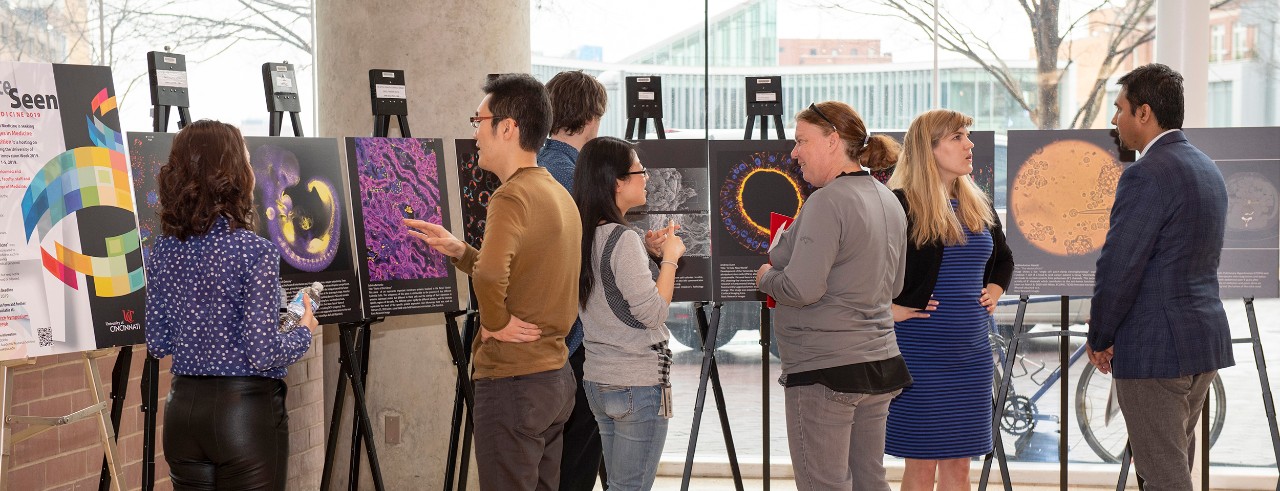
Featured photo shows spectators at a 2018 research symposium hosted by the UC Department of Internal Medicine in CARE/Crawley Building. In the midst of the COVID-19 pandemic this year’s symposium will be virtual. Photo by Colleen Kelley/UC Creative + Brand.
Related Stories
Sugar overload killing hearts
November 10, 2025
Two in five people will be told they have diabetes during their lifetime. And people who have diabetes are twice as likely to develop heart disease. One of the deadliest dangers? Diabetic cardiomyopathy. But groundbreaking University of Cincinnati research hopes to stop and even reverse the damage before it’s too late.
App turns smartwatch into detector of structural heart disease
November 10, 2025

An app that uses an AI model to read a single-lead ECG from a smartwatch can detect structural heart disease, researchers reported at the 2025 Scientific Sessions of the American Heart Association. Although the technology requires further validation, researchers said it could help improve the identification of patients with heart failure, valvular conditions and left ventricular hypertrophy before they become symptomatic, which could improve the prognosis for people with these conditions.
Combination immunotherapy helps overcome melanoma treatment resistance
November 10, 2025

MSN highlighted research led by the University of Cincinnati Cancer Center's Trisha Wise-Draper showing a combination of immunotherapy medications can activate a robust immune response and help overcome treatment resistance in patients with refractory melanoma.