Salon: How a debate over two competing vaccines gripped the medical community — in 1961
Polio vaccine developed by UC's Albert Sabin embraced by world, then U.S. 60 years ago

When a polio epidemic swept across the globe for much of the 20th century, a pair of researchers raced to develop a vaccine to halt the disabling virus that could lead to paralysis.
Salon.com is out with an in-depth feature story about the efforts of Albert Sabin, a University of Cincinnati researcher, and Jonas Salk, a University of Pittsburgh scientist. Both are credited with incredible breakthroughs that ultimately led to eliminating the virus in most of the world. According to the Centers for Disease Control, no cases have originated in the United States since 1979.

Dr. Albert B. Sabin was a pre-eminent medical investigator from the University of Cincinnati and Cincinnati Children's Hospital who dedicated his life to researching the causes and cures of viruses and disease.
According to the Salon article, "the U.S. felt that Salk's vaccine had solved the polio problem and there was no need for another vaccine. So, Sabin turned to other countries for support.
"In the Soviet Union, millions of people participated in a clinical trial. With its success established, the Soviet Union began manufacturing Sabin's vaccine. It is remarkable that at the height of the Cold War an American polio vaccine got its first foothold in the communist world. Eventually, Sabin's vaccine would be approved for use in the United States in 1961 and, in a victory for Sabin, replaced Salk's vaccine in 1962."
Read the complete article
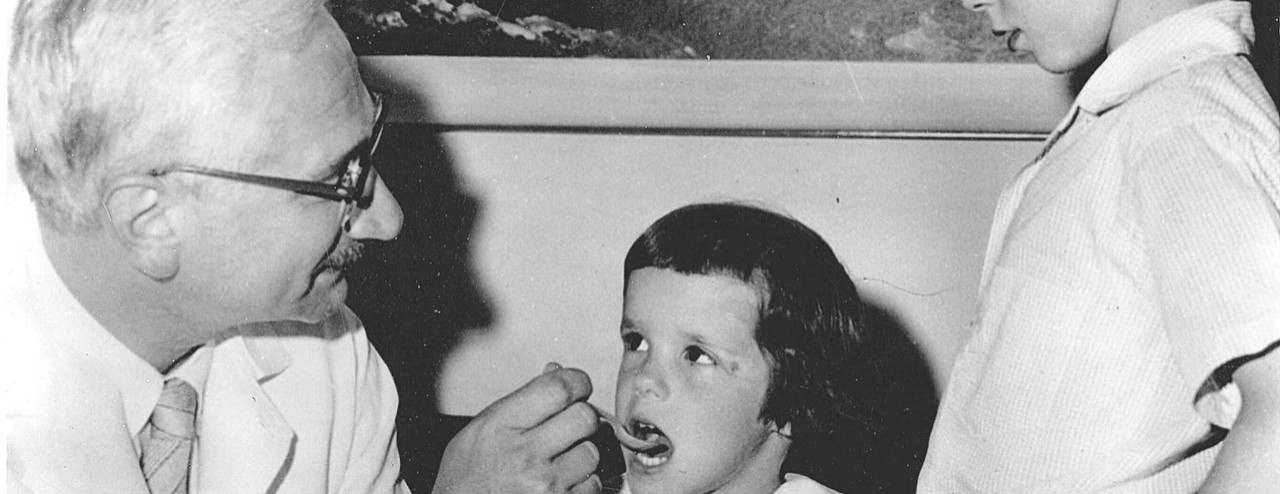
Featured image at top: Albert Sabin, MD, administers the live oral polio vaccine to children.
Impact Lives Here
The University of Cincinnati is leading public urban universities into a new era of innovation and impact. Our faculty, staff and students are saving lives, changing outcomes and bending the future in our city's direction. Next Lives Here.
Follow all of UC's advanced related to the COVID-19 vaccine, or schedule a virtual visit to UC and begin picturing yourself at an institution that inspires incredible breakthroughs.
Related Stories
Sugar overload killing hearts
November 10, 2025
Two in five people will be told they have diabetes during their lifetime. And people who have diabetes are twice as likely to develop heart disease. One of the deadliest dangers? Diabetic cardiomyopathy. But groundbreaking University of Cincinnati research hopes to stop and even reverse the damage before it’s too late.
Is going nuclear the solution to Ohio’s energy costs?
November 10, 2025

The Ohio Capital Journal recently reported that as energy prices continue to climb, economists are weighing the benefits of going nuclear to curb costs. The publication dove into a Scioto Analysis survey of 18 economists to weigh the pros and cons of nuclear energy. One economist featured was Iryna Topolyan, PhD, professor of economics at the Carl H. Lindner College of Business.
App turns smartwatch into detector of structural heart disease
November 10, 2025

An app that uses an AI model to read a single-lead ECG from a smartwatch can detect structural heart disease, researchers reported at the 2025 Scientific Sessions of the American Heart Association. Although the technology requires further validation, researchers said it could help improve the identification of patients with heart failure, valvular conditions and left ventricular hypertrophy before they become symptomatic, which could improve the prognosis for people with these conditions.