Scientific American: Tree snakes create 'lasso' to climb
UC biologist Bruce Jayne helped discover a new way that snakes can move

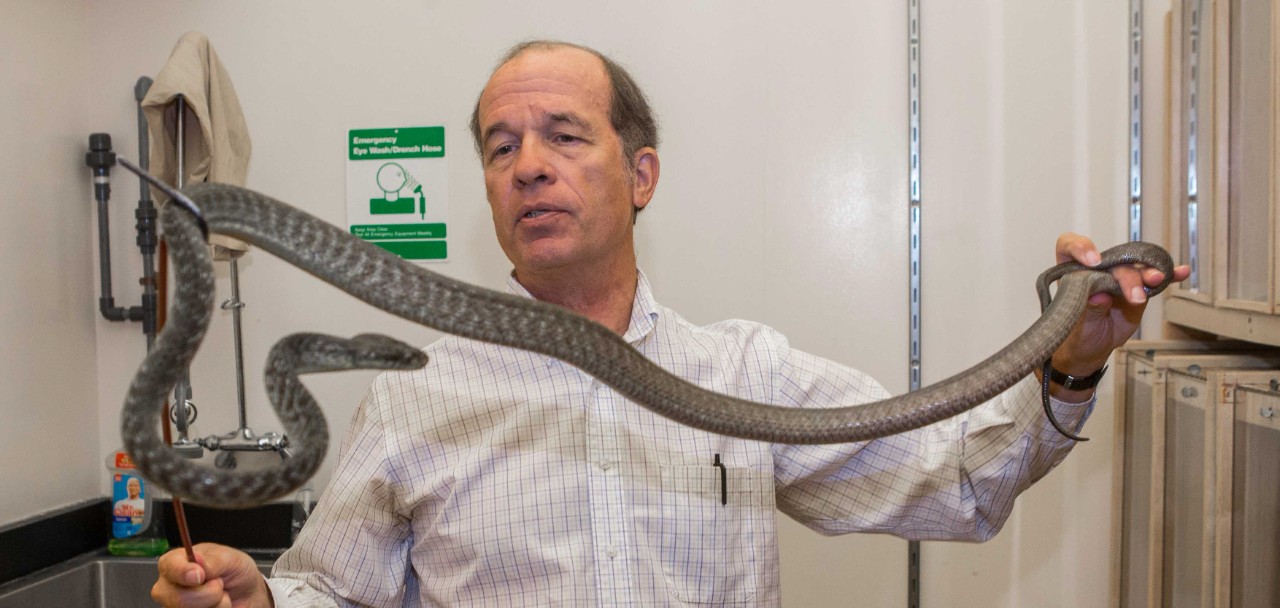
Scientific American talked to University of Cincinnati professor Bruce Jayne about the startling discovery of a new kind of snake movement he and his collaborators are calling "lasso locomotion."
Jayne and biologists Julie Savidge and Thomas Seibert from Colorado State University described a new form of snake movement in an article published Jan. 11 in the journal Current Biology.
Jayne previously described in detail the mechanics behind the other ways that snakes slither, climb, reach and burrow. But this discovery was extraordinary, he told Scientific American.
"This lasso locomotion is just from outer space compared to all of the other variations," Jayne said. "I've been studying the locomotion of snakes on and off for more than 40 years and I was absolutely stunned."
More locally, WVXU also spoke to Jayne about his startling discovery.
"It is a really bizarre way of moving that allows snakes to climb big cylindrical surfaces," Jayne told WVXU.
UC and CSU's discovery in the news

UC biology professor Bruce Jayne attempts to get a brown tree snake to climb a wide cylinder using lasso locomotion. He and researchers from CSU described this behavior for the first time. Photo/Bruce Jayne
National Geographic: Invasive snakes move their bodies like lassos, a totally new mode of locomotion
CNN: Snake turns its body into a lasso to climb smooth surfaces
Science: Guam's invasive tree snakes loop themselves into lassos to reach feathered prey
New York Times: These Snakes Found a New Way to Slither
The Times of London: Snake turns into lasso to climb trees
Huffington Post: Oh, Good, Scientists Discovered Snakes Can Turn Their Bodies Into 'Lassos' To Climb
Gizmodo: Snakes Invented an Incredibly Creepy Way to Climb Trees
Science Daily: This tree snake climbs with a lasso-like motion
Le Monde: The snake that hunts with a lasso
WVXU: 'It's Bizarre': Scientists Discover A New Way Snakes Can Climb
Related Stories
Sugar overload killing hearts
November 10, 2025
Two in five people will be told they have diabetes during their lifetime. And people who have diabetes are twice as likely to develop heart disease. One of the deadliest dangers? Diabetic cardiomyopathy. But groundbreaking University of Cincinnati research hopes to stop and even reverse the damage before it’s too late.
Is going nuclear the solution to Ohio’s energy costs?
November 10, 2025

The Ohio Capital Journal recently reported that as energy prices continue to climb, economists are weighing the benefits of going nuclear to curb costs. The publication dove into a Scioto Analysis survey of 18 economists to weigh the pros and cons of nuclear energy. One economist featured was Iryna Topolyan, PhD, professor of economics at the Carl H. Lindner College of Business.
App turns smartwatch into detector of structural heart disease
November 10, 2025

An app that uses an AI model to read a single-lead ECG from a smartwatch can detect structural heart disease, researchers reported at the 2025 Scientific Sessions of the American Heart Association. Although the technology requires further validation, researchers said it could help improve the identification of patients with heart failure, valvular conditions and left ventricular hypertrophy before they become symptomatic, which could improve the prognosis for people with these conditions.