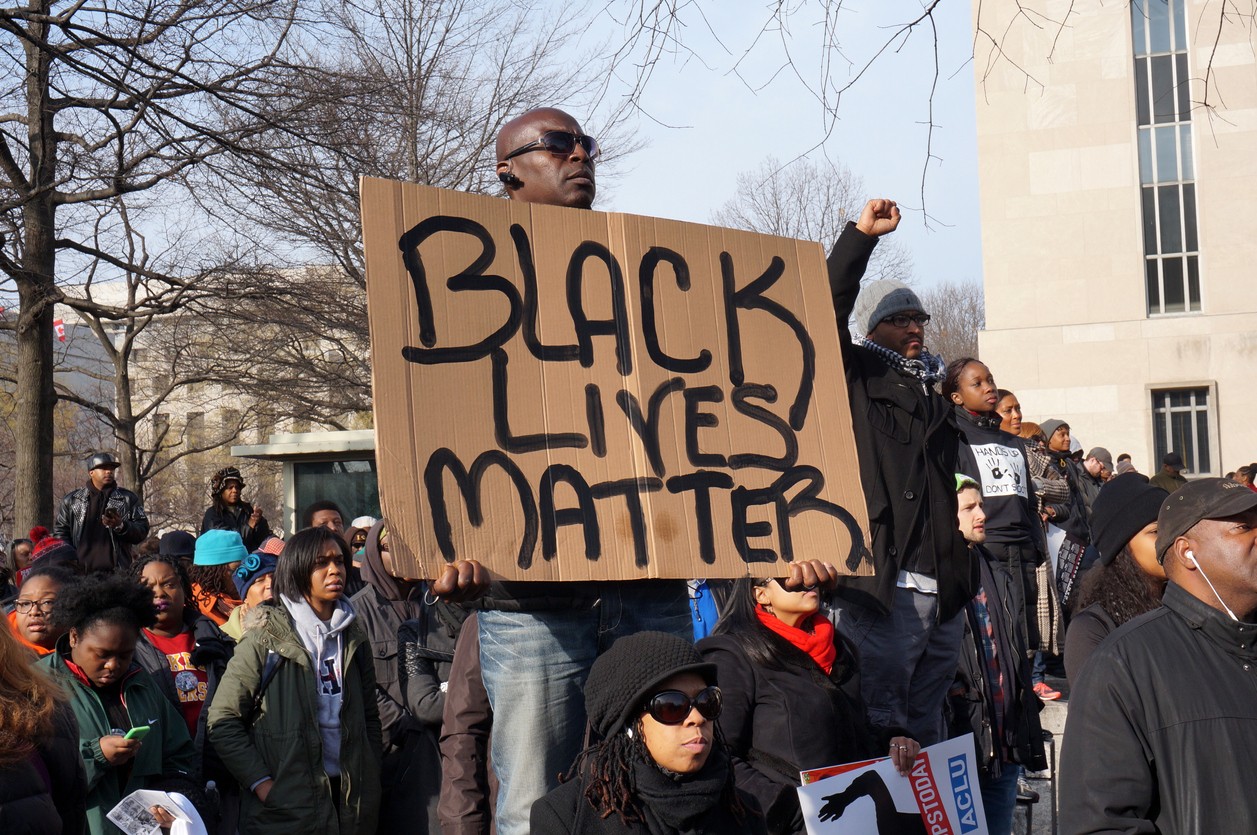
UC Law lecture to explore violence against Blacks, police brutality, reforms

Event Information (passed)
Majorities of both Black and White Americans say Black people are treated less fairly than whites in dealing with the police and by the criminal justice system, according to a 2019 Pew Research Center survey.
In the survey, 84 percent of Black adults said that, in dealing with police, Blacks are generally treated less fairly than Whites; 63 percent of Whites said the same. Similarly, 87 percent of Blacks and 61 percent of Whites said the U.S. criminal justice system treats Black people less fairly.
How did this happen and how can the country move forward? Paul Butler, the Albert Brick Professor in Law at Georgetown University Law Center, will explore the issue of state violence against Blacks, police brutality, and reform prospects in a University of Cincinnati-hosted law lecture.
“Chokehold: Policing Black Men in the Post-Trump Era,” the 2021 Distinguished Visiting Professor Lecture, will be held at 12:15 p.m., Thursday, Jan. 14, via WebEx. CLE: Application submitted for 1.0 hour of General CLE in OH and KY.
About the lecture
Butler’s presentation will explore the seeming permanence of state violence against Black bodies, including an examination of the history of police brutality directed at African American men. He will examine prospects for reform and transformation, including the "Defund the Police" movement.
About the speaker

Professor Paul Butler
Paul Butler is the Albert Brick Professor in Law at Georgetown University Law Center and a legal analyst on MSNBC. During the 2017-18 academic year he was the Bennett Boskey Visiting Professor at Harvard Law School. He holds an honorary Doctor of Law degree from City University of New York.
Butler is one of the nation’s most frequently consulted scholars on issues of race and criminal justice. His work has been profiled on 60 Minutes, Nightline, and the ABC, CBS and NBC Evening News. He lectures regularly for the American Bar Association and the NAACP, and at colleges, law schools, and community organizations throughout the United States. He serves on the District of Columbia Code Revision Commission as an appointee of the D.C. City Council; and, he was elected to the American Law Institute.
His scholarship has been published in many leading scholarly journals, including the Georgetown Law Journal, Yale Law Journal, Harvard Law Review, Stanford Law Review and the UCLA Law Review. Butler’s book “Let’s Get Free: A Hip-Hop Theory of Justice” received the Harry Chapin Media award. And his 2017 book “Chokehold: Policing Black Men” was named one of the 50 best non-fiction books of 2017 by The Washington Post, as well as one of the best books of the year by Kirkus Reviews and the Atlanta Journal Constitution. Additionally, the New York Times described Chokehold as the best book on criminal justice reform since The New Jim Crow. It was a finalist for the 2018 NAACP Image Award for best non-fiction.
Prior to joining the academy, Butler served as a federal prosecutor with the U.S. Department of Justice, specializing in public corruption. His prosecutions included a United States Senator, three FBI agents, and several other law enforcement officials.
A graduate of Yale University and Harvard Law School, he clerked for the Hon. Mary Johnson Lowe in the United States District Court in New York, and then joined the law firm of Williams & Connolly in Washington, D.C., where he specialized in white collar criminal defense.
Tags
Related Stories
Sugar overload killing hearts
November 10, 2025
Two in five people will be told they have diabetes during their lifetime. And people who have diabetes are twice as likely to develop heart disease. One of the deadliest dangers? Diabetic cardiomyopathy. But groundbreaking University of Cincinnati research hopes to stop and even reverse the damage before it’s too late.
App turns smartwatch into detector of structural heart disease
November 10, 2025

An app that uses an AI model to read a single-lead ECG from a smartwatch can detect structural heart disease, researchers reported at the 2025 Scientific Sessions of the American Heart Association. Although the technology requires further validation, researchers said it could help improve the identification of patients with heart failure, valvular conditions and left ventricular hypertrophy before they become symptomatic, which could improve the prognosis for people with these conditions.
Why the need for public schools
November 10, 2025

UC Law professor Joseph Tomain argues for continued government support for public schools in the online publication, The Conversation.